
By Mara Riegel, October 2025
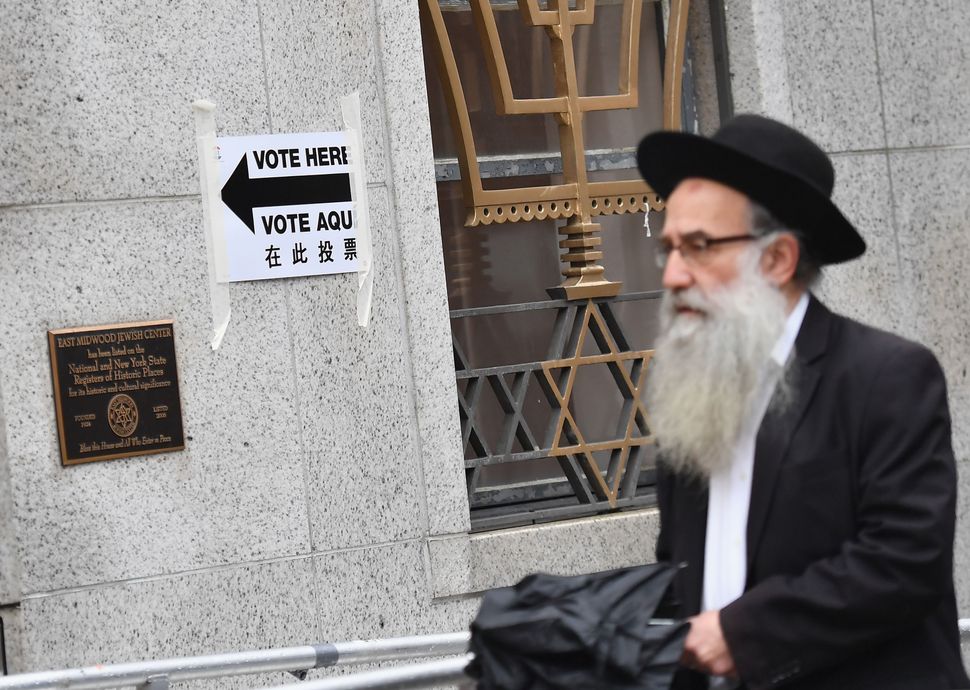
Credit: Forward.com
The United States’ political system doesn’t have the bandwidth for cultural identities to feel truly represented by our current party system. Many Americans know this and simply pick the party that, when voting with their identity, caters more to the issues that matter most to their own community. For example, Black Americans tend to vote more favorably toward voting rights and pro-choice initiatives. But different from most other religious and ethnic groups, Jews don’t have that kind of natural gravitation toward one side or another.
When I participated in the College Democrats vs. College Republicans debate last semester, I was asked a question by my opponent that at the time confounded and offended me, but later gave me much food for thought. He simply asked, “how can you be a Democrat and a Jew?” This question on its face is absurd; how do you relegate an entire religious and ethnic group into an expectation of Republicanism?
But this question tells us a lot as a society about what America expects of its Jewish population when voting. Society is at a recent high for incidents of anti-Semitism. At least personally, I watch who I talk about my opinions to a lot more now, and I stay wary of people I’m not too familiar with. It’s like rather than being multi-faceted and complex people, we’ve been relegated to a defensive position where we need to constantly reassure people of our innocence in society.
My opponent expected that by virtue of my Judaism, other issues that did not concern that part of my identity should not hold as much weight as issues that do in considering my political affiliations. The better question then becomes what issues as a Jew should make me a Republican?
To get into what issues “should” dictate my politics as a Jew, we must talk about how American Jewishness is interpreted and seen. I think a lot of the reasoning for that question I was asked had to do with what most Americans know about Jews vs. what they think they know about us and stereotyping. Many of us Jews have heard the comments about us hoarding our wealth or all being tied to Israel in a more tangible way than just a spiritual and ancestral connection. This question legitimized those stereotypes in a way that not only assumed their correctness, but also created a causal relationship.
Abiding by the standards of Jewish stereotypes, what are we left with? We have tax policy, Israel and the Middle East, anti-Semitism, and maybe abortion, though our religious perspective never seems to matter when that conversation comes up.
If we truly are to expect Jewish-Americans to vote on those issues alone and according to what everyone else thinks of our community, then maybe most Jews would be Republicans. But what that question failed to account for and what the calculation of Jewish voting responses still falls short on is the fact that we are not indeed stereotypes or caricatures.
There is so much diversity throughout our community that to generalize us all into a political expectation not only is anti-Semitic, but it is a disservice to the education available on the subject, and to the individual who moves through the world thinking that people are two-dimensional in that way. As a community, I don’t think that there is a single issue that the entirety of Jewish people agree on except for being against anti-Semitism, and even that is subject to interpretation with what can be defined as anti-Semitic.
Moreover, while some may expect all Jews to fall in line with one particular political party –in this case the Republicans– there is yet another important factor they leave out of consideration: people never consider how the parties themselves actually treat the Jewish community.
I’ve heard people argue time and time again that the Republican Party is the only party that truly supports the Jews. However, that takeaway is a fallacy. The Republican Party, in their action that they’ve taken “on behalf” and “in support” of the Jews, have never actually improved our lives. They have treated us as political pawns and bargaining chips, and put a larger target on our backs than we had before.
When Donald Trump moved the American Embassy in Israel to Jerusalem, it was supposed to be both a sentimental gesture, as well as a diplomatic one to show the Palestinians that America’s allegiance is with Israel. While it’s nice that that happened, it didn’t do anything to improve our quality of life and it didn’t stop Hamas from coming to power and hurting people, including dual American-Israeli citizens like Omer Neutra.
On a recent level, the DOJ taking on higher education institutions in the name of combatting anti-Semitism, withholding their funding, monitoring their curriculum, and disallowing students from other countries has only further hurt the Jewish community. By making these deeply unpopular decisions in our name, the federal government has given those who are upset about what’s happened a group to which they can direct their anger.
The Democratic Party, however, is no better. The Democratic Party doesn’t even pretend to care about Jewish-Americans most of the time, and they certainly have made it clear that they don’t feel an inclination to help protect our ancestral land and the US’s relationship with it. Far-left Democrats today are a very significant portion of those committing anti-Semitic offenses on college campuses today, and frankly they can more often than not make me scared to talk about my culture around them. You know your party is hostile toward the Jews and Israel when even a gender-fluid, bisexual, neurodivergent woman from New York feels uncomfortable speaking about her culture around Democrats.
So where do I and other Jews fit in the political landscape of America? The short answer is nowhere really. Instead, I, as well as many other Jews like me, pick where we feel the most seen for the other facets of our lives. For me, that’s the Democrats, because even if I can’t talk about my culture, they won’t try to take away my civil rights and liberties, and at least they want me to be able to afford my prescriptions. Yet, I become more and more center-independent every day. This together, is why we say that Jews don’t fit a party in America, and this is why we must be considered holistically, rather than two-dimensionally when we cast our ballots.


 Tekiah Magazine
Leave a comment