
By Rabbi Daniel Epstein, December 2025

Credit: Lila Kokolas/Jewish On Campus GW
“No religion is an island. We are all involved with one
another, and the one is responsible for the other.” —
Rabbi Abraham Joshua Heschel
In the early 1960s, Rabbi Abraham Joshua Heschel had
a dream: to establish an interfaith center in the heart of our
nation’s capital. Though that dream went unrealized during
his lifetime, it has now come to fruition. This year, George
Washington University officially launched the Center for
Interfaith and Spiritual Life, located just six blocks from the
White House, in the heart of Washington, D.C. Under the
inspiring leadership of the incredible Rev. Kristen S. Glass
Perez, the center brings together clergy from the National
Cathedral, the National Mosque, and other faith traditions to
build bridges, engage students, and foster interfaith dialogue
across the GW community.
By engaging deeply with other faiths, by truly learning and
listening, we paradoxically come to know our own religion
more fully. To paraphrase a Jewish teaching, who is the
wise one? One who learns from every daughter and son. The
Jewish mystics taught that everything we see and hear can be a
message from God about how to better serve the Creator.
From the Muslim tradition, I learned that fasting during
Ramadan is meant to sensitize believers to the suffering of the
hungry. This direct experience of hunger cultivates empathy
for those who fast not by choice but by circumstance. While I
have not found this idea stated explicitly in Jewish sources, I
now reflect on it during our own fast days. It adds a profound,
experiential dimension to my Jewish practice. Speaking with
Imam Talib and his assistant Fitrah Muhammad throughout
the semester enriched my practice of Judaism. One day, I went
to Zingers to meet a student and I saw Fitrah and Imam Talib
eating lunch together in the Hillel cafe. That was one of the
highlights of my semester, the interfaith center brought us
together.
When I spoke on Sukkot at Kesher Israel, the local
synagogue in Georgetown, I shared what I had learned from
the Buddhist tradition about mindfulness and presence. I
compared the Sukkah, a temporary dwelling for seven days, to
a meditation hut, and drew on a Zen koan to illustrate the art of
being fully present. Obviously, my connection to Amitha the
Monk this semester influenced my perspectives and my reading
material, another relationship I formed through the Interfaith
center. While mindfulness is a part of Jewish spirituality,
Buddhism offers a beautifully developed model for this state of
awareness and I find the disparate explanation clarifying.
Interfaith learning also requires courage, the willingness to
explore our differences. In conversations with Father James,
the Catholic priest on campus, I discovered how profoundly
the Christian conception of the afterlife differs from the
Jewish one. These discussions clarified my own beliefs and
deepened my understanding of my faith. We did an interfaith
event together about Abrahamic views on the Afterlife. During
Interfaith week, we had a priest, an imam, and a rabbi talk
about what happens after you die.
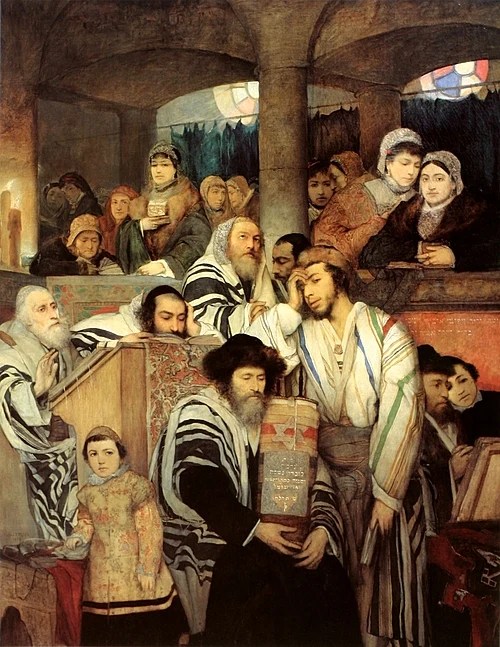
This exchange of learning flows both ways. When George
Washington University President Ellen Granberg spoke at our
Yom Kippur service, she shared that in preparation for her
speech, she conducted research on Teshuvah, the practice of
repentance and reflection in the Jewish tradition. She said she
had long engaged in similar practices of introspection and
growth, but had recently found insightful language for them
through Judaism’s teachings on Yom Kippur.
Earlier this semester, I was invited to speak at the Museum
of the Bible to 300 Christian college students who had just
returned from Israel through the Passages program. The
organizers asked me to explain the Sabbath from a Jewish
perspective. I noted that both Christians and Jews say a blessing
before a meal, but that Jews also recite a prayer after eating,
a custom not typically found in Christian practice. When a
student asked why I found that “interesting,” what did I mean
by that? I explained simply that curiosity, not judgment, guides
my learning. I really just found it interesting that these practices
are similar and different.
This is the advice I offer to students. We are all lifelong
learners. Those in college may have the advantage of
recognizing it, but everyone on earth is a student from the
moment we open our eyes for the first time until we return to
the dirt. When we encounter a faith or worldview not our own,
we should resist judgment and instead engage with openness.
Curiosity is the beginning of understanding. We should be open
to having an encounter and an experience.
If you have a chance, stop by the interfaith center, and try
to expose yourself to a religious tradition that is not your own;
you could learn a great deal about your own faith and about
yourself.
“Interfaith work is not about watering down your faith. It’s
about drawing from the deepest well of your own tradition to
build relationships with others.” —Dr. Eboo Patel

 Tekiah Magazine
Leave a comment