
By Brady Wilson, December 2025
Credit: Fox News
Antisemitic incidents have erupted worldwide since the October 7, 2023, attacks, signaling an unprecedented mix of security enhancements and education crackdowns. Since October 7, there has been a documented sharp rise in antisemitic incidents that spans over continents. In the United States, the Anti-Defamation League (ADL) reported a record 9,354 antisemitic incidents in 2024, a 5% jump from 2023 and a roughly 344% increase over five years.
Campus life has been particularly affected, where Hillel International recorded 2,334 antisemitic incidents on U.S. campuses in the 2024-25 school year, a tenfold jump from 289 incidents in 2022-23, the last year before October 7. “This is the most hostile environment Jewish students have faced in modern campus history,” one Hillel leader said, warning that antisemitism is “no longer at the margins of student life.”
In the U.S., specifically in New York City, it has become a test case for action. In July 2025, Mayor Eric Adams signed an executive order requiring all city agencies to use the International Holocaust Remembrance Alliance (IHRA) definition of antisemitism, an attempt to bring consistency to how complaints are logged and investigated. City officials paired the move with a new Mayor’s Office to Combat Antisemitism and tighter coordination with the NYPD, including stepped-up synagogue perimeters, targeted patrols, and rapid-response deployments during Jewish holidays.
Nationally, the federal government has leaned on universities and law enforcement. Rising campus incidents, up 84% in an ADL analysis between 2023 and 2024, have prompted more hate‑crime investigations into schools accused of failing to protect Jewish students. One senior Justice Department official, speaking at a 2025 conference on hate crimes, called the campus trend “a civil rights emergency” and pledged that “no university will be allowed to look the other way when Jewish students are targeted.”

Credit: ADL
In Europe, governments are trying to blend long-term education with immediate protection. Sweden has appointed national antisemitism coordinators to align ministries and police, a move Swedish officials say is meant to avoid the “siloed” responses that failed in the past.
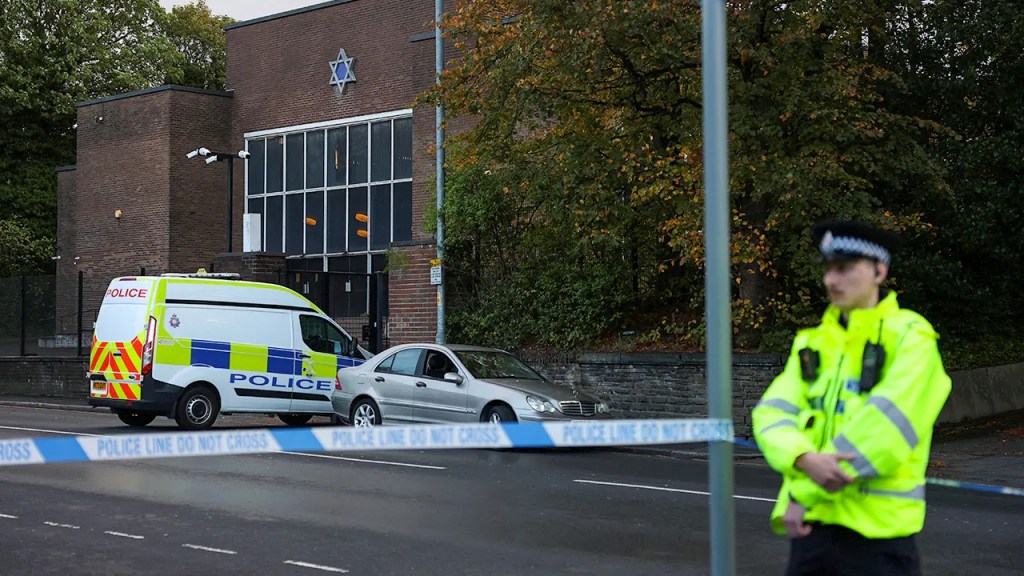
In the United Kingdom, a 2025 vehicle attack near a Manchester synagogue became a breaking point. The attack spurred new funding for Jewish community security and pushed curriculum changes meant to strengthen Holocaust and antisemitism education in schools, according to British government statements and Jewish security briefings. One Jewish community representative in Manchester described the attack as “a brutal reminder that rhetoric has consequences on our streets.”
Germany, where the memory of the Holocaust is central, has seen its own sharp uptick in antisemitic incidents since October 7. The Federal Interior Ministry says security services moved to heightened alert immediately after the attacks, coordinating with all 16 Länder to increase protection for synagogues, schools, and Israeli institutions. “Zero tolerance for antisemitism” has become a recurring phrase in official communications, as police add patrols and tighten surveillance at Jewish sites.
Given the actions already taken, groups are urging the government to take further steps. A new initiative, “DACH Against Hate,” launched in 2025 to confront growing antisemitism in Germany, Austria, and Switzerland, combining protests, petitions, and a five‑point policy plan. Organizers are seeking at least 100,000 signatures to press parliaments in Berlin, Vienna, and Bern to strengthen laws, expand education, and increase protection for Jewish institutions.
Holocaust survivor Charlotte Knobloch has warned that the recent escalation feels like “a breaking of taboos” in public discourse. “We are seeing things shouted openly that were once unthinkable in Germany,” she said, backing the new initiative.
Australia has experienced one of the steepest increases in antisemitic incidents in the world, up an estimated 316% since October 2023, according to the Executive Council of Australian Jewry. The surge includes attacks on synagogues, Jewish schools, and Israeli‑owned businesses, as well as a widely known arson at a Melbourne synagogue.
In response, the federal government appointed Jillian Segal as Australia’s first Special Envoy on Antisemitism in 2024. In July 2025, she released a detailed multi‑step plan that ties government funding to performance on antisemitism, recommends penalties for universities that fail to respond to campus hate, and calls for monitoring of extremist ideologies and media coverage. The plan also pushes for mandatory Holocaust education and funding restrictions on arts and cultural institutions that promote antisemitic narratives, a package Segal has framed as an effort to “push antisemitism back to the fringes of Australian society.”
In Canada, the federal government recently announced the Canada Community Security Program (CCSP), an expanded successor to the Security Infrastructure Program, with an extra 65 million Canadian dollars earmarked to help vulnerable communities harden their facilities. The Centre for Israel and Jewish Affairs (CIJA) welcomed the move, warning that Jewish schools have been shot at, synagogues vandalized, and community centers terrorized at levels “not seen since the Holocaust.”
“Parents were scared to send their children to school, congregants were prevented from entering synagogues,” CIJA president Shimon Koffler Fogel said, calling the new funding “timely” ahead of the High Holidays and the October 7 anniversary. But advocates fear the momentum they have now might not continue. In coverage of the 2025 “Canada Strong” federal budget, some Jewish community figures criticized the government for failing to increase long‑term security funding despite the continuing wave of incidents.
For many Jewish communities, the post-October 7 surge in antisemitism is both a security emergency and a moral stress test for democracies that vowed “never again.” The numbers are stark: record totals in the United States, double‑digit or triple‑digit percentage increases across Europe and Australia, and a range of campus incidents that would have been unthinkable a few years ago.
The responses of new laws, dedicated envoys, security funds, and classroom initiatives are more coordinated than in previous waves, but their continuity is uncertain. As Charlotte Knobloch put it in Germany, “the time for speeches is over,” a sentiment to those who say the real measure will be whether Jewish children can attend school, walk to synagogue, and live openly as Jews without needing a security plan.



 Tekiah Magazine
Leave a comment