
By Archer Berenson, December 2025
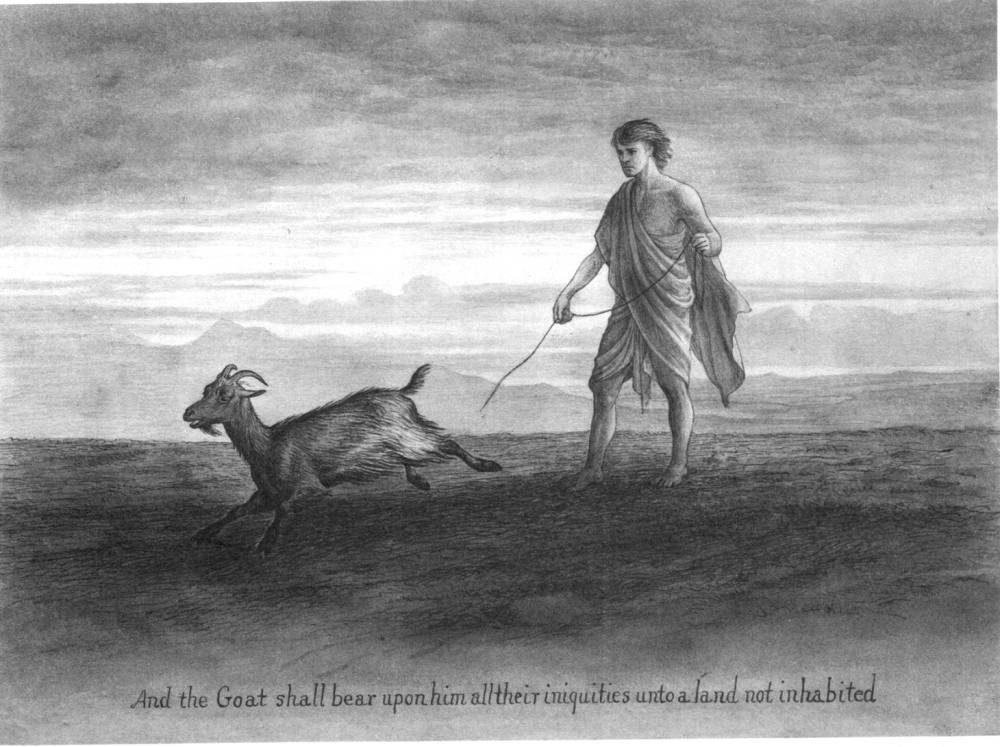
Credit: Jemima Blackburn
In ancient Israel, during Yom Kippur (the Day of Atonement), two goats were chosen at the behest of G-d: one to be sacrificed and one, the scapegoat, to have the sins of the community symbolically placed upon it and then be released into the forest. Once released, the hope was that the scapegoat would never return, and thus the sins placed upon it would be forever excised from the community. I imagine these ancient Israelites watching on as this affair occurs. What kind of feeling does witnessing the first goat, no doubt trembling with terror, being brutally slain evoke? What kind of relationship does that imply between the Israelites and G-d? Between G-d and His creations? Why would G-d demand of His chosen people such a graphic display of fealty? The questions beget yet more questions. But it is the second goat, the one that lives, that invites the darkest revelations.
This goat too trembles with fear, unable to make sense of what is happening to it. Saddled with the burden of the collective sin of ancient Man, this creature becomes a vessel for, even a physical manifestation of, evil itself. It will die out there in those woods. In all that dark and all that cold. When it leaves, the Israelites know that it will not, can not, return. I imagine them in their beds at night, as the desert wind gently passes through their camp, and I can feel the void where catharsis should be. Why have the heavy chains of sin not been supplanted by the lightness of virtue? Why is the evil within still so clearly alive after the scapegoat has been banished?
Perhaps the answer lies not in the ritual itself, but the illusion it sustains. The goat carries the sins with it into the woods, but the woods are not a cosmic incinerator. They are silence. They are refusal. They are abdication. The goat still wanders aimlessly beneath the stars and the canopying trees waiting to face obliteration. It does not take with it anything the people do not give it freely. It is not a cure. It merely reveals the depth of Man’s need to believe in a cure. If one really dwells on it, it becomes obvious that the ritual is not even about sin at all. It is about comfort. It is about the undeniable relief that comes when someone else, something else, is made to walk out into the darkness in your place. The Israelites did not watch the goat and see their sins upon it; they watched it and felt the loosening of the noose around their own necks. They watched it disappear into the trees and convinced themselves that something fundamental had shifted. The tragic irony that we know, and they knew too, on some level, is that nothing but the focus of blame really had shifted.
We tell ourselves we’ve evolved beyond such primitive spectacles, that this kind of thinking belongs to the dust of antiquity and the superstition of ancient peoples. Yet the mechanism, stripped of its idols and altars, persists in the modern mind. Two Israeli embassy employees were murdered this year on American soil. They were not architects of war, but were chosen merely by association, by proxy. They, like the second goat, were selected because they were there. Because they were accessible. In doing so, their killer engaged in the perennial scapegoat tradition: he mistook the visible for the responsible. He confused the proximate for the guilty. He conflated cruelty for purification. It is the same ancient story revived in modern dress, and it reveals a chilling truth: we no longer believe in sacrifices, but we still believe in sacrificial logic. As thousands online rally to support the murderer, and condemn the murdered, we owe it to Yaron Lichinsky and Sarah Milgram to ask the questions which hang heavy in the air: whose sins did the young, murdered Israelis carry with them into the grave? And who sleeps better now that they are gone?
This is not Ancient Israel. And the forest is not empty. The truth, revealed to the point of redundancy, is this: the scapegoat ritual works not because it cleanses, but because it displaces. Once we are persuaded that our sins will be lifted from us if the vehicle arbitrarily selected to bear those sins is destroyed, the most unspeakable horror does not become merely possible; it becomes imperative. It becomes rite and ritual. It becomes a mandate from G-d Himself.
And what of the goat, the goat that lives? What if the sins do not burn in the wilderness, but fester? What if one day, long after the ritual is forgotten, it returns; emaciated, revenant, bearing not only their ancient sins, but the memory of a people too eager to forget them?


 Tekiah Magazine
Leave a comment