
By Ariella Mandell, October 2025
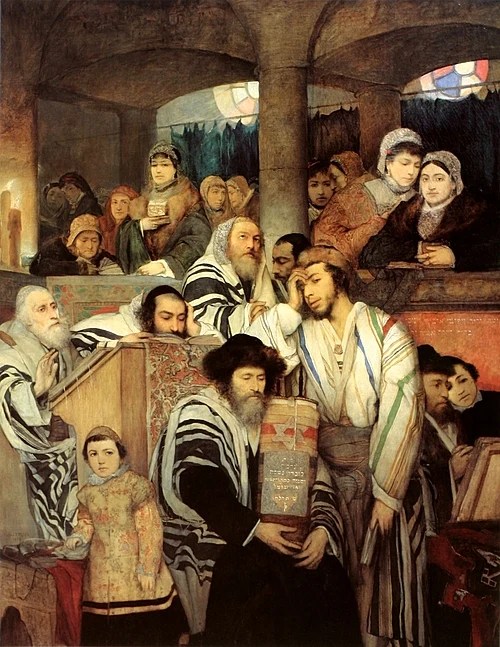
Credit: Maurycy Gottlieb
“Have a happy Yom Kippur,” my professor called out to me as I left the classroom after my midterm on Tuesday. I smiled and thanked him without correction, as I left the classroom and began my walk back to my dorm.
As I walked through Kogan, I bumped into a friend and we stopped to talk. I mentioned to her that I was going home on Wednesday, and when I told her it was for Yom Kippur, I had to hide my surprise when she asked “what’s that?”
Now, I am not ignorant. I know that most Americans have only heard of Hannukah, and maybe Rosh Hashanah if you’re lucky out of all the Jewish holidays. But it still took me by surprise that a day so holy, so sacred to me and so many others, could not exist in every person’s mind.
Many of those I have met who do know what Yom Kippur is, are still unclear of its meaning. They believe we are either celebrating something, or fasting as a form of punishment, neither of which are completely true. I have compiled together a list of infrequently asked questions about Yom Kippur, that can help educate those who are unaware of their answers. I call it Yom Kippur for dummies.
First of all, what is Yom Kippur? Well, Yom Kippur is widely considered to be both the most solemn and the holiest day of the year for Jewish people. The idea of Yom Kippur is that it is a day for us to atone for the sins we have committed over the past year to both God and others. It is a day full of self reflection, prayer, and occasionally a few apology texts to people you may have hurt or wronged.
Personally, I take Yom Kippur as a time to go home. I spend most of my day in the synagogue that I grew up in. I find it hard to reflect at school, given that it is a place with such weighted emotions. By atoning at home, I find myself able to be closer to the points in time where I was the best version of myself, surrounded by the people that have raised me to be the best version of myself.
When was the first Yom Kippur? Some scholars actually cannot agree on this one, believe it or not, but for the most part we say that the first Yom Kippur was preceded by Moses’ “golden calf incident.” This is the story I was told when I was a little kid sitting in Hebrew school, and so this is the story I will share with you all.
In this story, Moses was given tablets with the ten commandments on them from God at Mount Sinai. While this was happening, the Israelites were creating and worshipping a golden calf. This caused God to get angry because Jewish people do not worship idols, only God, and God broke the tablets with the commandments. After 40 days of Moses pleading with God on Sinai, God decided to forgive the Israelites, and presented Moses with two new tablets. This act of forgiveness happens on the 10th of Tishrei, the first month on the Jewish calendar, which is the day we now celebrate Yom Kippur every year, ten days after Rosh Hashanah.
Now that brings up the question of why is Yom Kippur ten days after Rosh Hashanah? Well, these 10 days are usually referred to in English as the “10 days of repentance” or the “10 days of awe.” Think about how on New Years most people make resolutions. These resolutions are used as a way to improve for the coming year. These ten days reflect a very similar concept.
Jewish people, like most, believe that we should start the new year off on a good note. Because of that, these ten days after Rosh Hashanah are spent reflecting on how we can do that. How we can treat other people more kindly, and do better in this world. During these ten days, personally, I aim to reflect on my experiences in the past year, think about anyone I have hurt, and how I can work to do better in the upcoming year.
I also like to think about projects I can help with that allow me to give back to my community, and what part I can take in helping make the world a better place. Some examples that I have done in more recent years include volunteering at a soup kitchen by my house and also helping with get out the vote work!
Why do we wear white on Yom Kippur? Traditionally, many Jews wear white to services on Yom Kippur, and there are two main reasons for this. The first meaning is to signify purity, and how we are going into the new year with a clean slate. The second, more biblical, reasoning is that we are attempting to be as close to angels as possible on this day. Another reason that I really like the idea of us all wearing white because we are all equal on this day in the eyes of God.
Next, let me address the elephant in the room that I am sure you all are wondering. Why exactly do we fast, if not as a punishment? The answer to this, is just so that we are able to focus more closely on our spirituality, and not to be distracted by needs for physical things. It is an act of solidarity with those who have suffered before us. It is not meant to be a punishment, it is meant to help us reflect and learn to be the best versions of ourselves!
What does the fast look like? Now this one is my question that I am asking for you. I am sure you all have an image in your head of what a fast should look like. No food or water all day. But it is actually a lot more complicated than that, and it is important to note that everyone’s fast looks different, and that is more than okay. The traditional fast goes from sundown to sundown, and is a 25-hour fast. During this time, many people do not eat food or drink water. In addition to that, many do not wash themselves, or wear leather. On top of those, many treat Yom Kippur as a typical Sabbath, where they abstain from any work. This involves no driving, turning on lights, or writing, to name a few.
There it is, Yom Kippur for dummies in a nutshell. Now you understand that this day is neither a punishment nor a celebration. It is a day of reflection for how we hurt others in this past year, and how we can work to right our wrongs in the future. As I write this, I reflect on my personal ignorance when it comes to other cultures. Most holidays that I know the names of, I know nothing about in terms of their deeper meanings.
Not only that, but I am sure that there are hundreds of holidays or simply special days that I do not even know the names of. Because of that, may this article be a lesson to you and me both. Whether you are Jewish or not, maybe we can all take this new year, 5786, as a chance to take the time to learn about other religions and cultures, and the days that they hold close to their hearts. The first step to overcoming ignorance is curiosity.



 Tekiah Magazine
Leave a comment