
By Archer Berenson
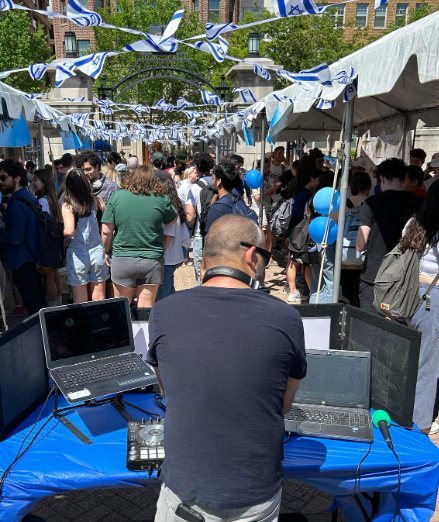
Credit: GW For Israel
I believe strongly in the state of Israel’s right to exist. I supported Israel when it attempted to eliminate Hamas and free the hostages, which it surely had to do. I was very skeptical when Rear Admiral Daniel Hagari of the Israeli Defense Forces (IDF) claimed that, “While Hamas hides behind civilians, Israel does its best to distinguish between civilians and terrorists,” especially as the civilian death toll in Gaza continued to rise. I am beyond critical of the government of Prime Minister Benjamin Netanyahu, which has made the world a more dangerous place to be Jewish partially because it has perpetrated war crimes in Gaza. Israel is currently in a fragile ceasefire with Lebanon and Iran, and continues to allow settler terrorists to attack Palestinians in the West Bank.
In the midst of all this, the abominably-named Israelfest feels obscene in the absence of some humility about Israel’s failings and existential political crisis. Defenders of this event will be quick to note that this event is strictly cultural and, after all, what is wrong with a celebration of Israeli culture, especially during a fraught political moment?
The subtext is obvious. When you name an event ‘Israelfest’, you are inviting a celebration of that country’s culture, politics, and whatever is happening in the place at that given moment. For the same reason that it might be strange to run an Americafest right now, it seems rather inappropriate to run an event, “In celebration of Israel,”while Israel has just recently committed, arguably, the worst crimes in its history (GW For Israel). Israeli culture is not the cause of those crimes, but celebrating one while ignoring the other is tone deaf.
Further, if the event is truly cultural, it is unconscionable to pretend that political matters are irrelevant. Israeli culture is far more than its food. Israeli society’s view of Palestinians has reached its nadir. Polls consistently show that Israeli political views are becoming more right wing and militant as Netanyahu’s adventurism in the region has led to catastrophes at home. Is this not an expression of culture? Is this really worthy of celebration? If we supporters of Israel are honest with ourselves, it is obvious that the Israeli-Palestinian conflict has been a significant catalyst for the development of Israeli culture over the last 80 years. A celebration of Israeli “culture” (with whatever abstract definition is being applied) during a time of war and conflict is not an act of political neutrality.
None of this is to suggest that Israeli culture should not be visible, or even celebrated; the question is how? Israelfest does not occur in a vacuum. This year, it happened in the context of an odious and violent chapter in Israel’s history. Not to mention the fact that, on GW’s very campus, Israeli politics has been the subject of endless debate, consternation, and protest. That doesn’t mean that we shouldn’t have Israelfest. If anything, we need it now more than ever. It should be renamed, but Israelfest could be an important venue for discussing the contradictions inherent in this moment in Israeli politics and society. There could be Israeli food, song, and dance alongside the sobering realities of everyday life in the Jewish state. I am sympathetic to the Israeli and/or Jewish students who just want a pause from the despair and heartbreak of the ongoing situation in the region, but if you host an Israeli cultural event at this moment that does not acknowledge the fraught political and social reality on the ground, that is disingenuous.
Israelfest came across as an unseemly and uncritical expression of support for Israel. I understand that Israelfest has been happening since before Israel was at war in Lebanon, Iran, or Gaza, but when a country is subject to a major social, cultural and political change, events which purport to celebrate that country ought to change too. This year, Israelfest should have leaned into the chaos in the region and opened itself up as a space for dialogue. It should have been an event that calibrated the conversation where, instead of focusing purely on political matters, could have accurately displayed the parts of Israeli culture worth celebrating alongside the parts that make us uncomfortable. Instead, it was a party, like it always is. There was a camel there. As if camels are Israeli.
GWI must demonstrate that it has the tact to portray Israel in an accurate light, because this moment is the worst possible time for an exercise in collective evasion. If we want to celebrate Israeli culture, we should do so ethically by acknowledging the full breadth and scope of what we are celebrating. If the pro-Israel community at GW, of which I am proud to be a part, wants to be taken seriously on this campus, it cannot afford to look like it is dancing on the graves of Israel’s many victims. A real celebration of Israeli culture would be brave enough to include the parts that break our heart. Israelfest will happen again next year. The only question is: will GWI have the courage to let it mean something?


Leave a Reply