
By Daniella Nissim
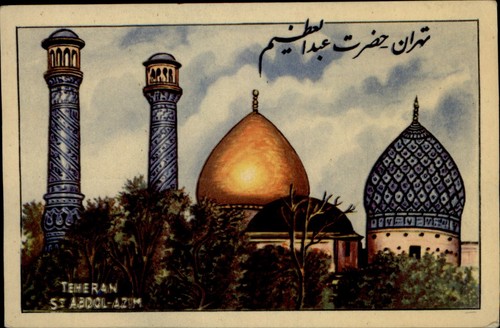
Credit: Umpteen Postcards
My grandmother keeps a photograph of Tehran on her kitchen wall from over thirty years ago. Not a postcard but a real photograph, blurry and sun-yellowed, of the Alborz Mountains rising behind the city she left in 1979. She never went back. Being born in America, I never got to visit the place she calls home. I have never needed to go back to feel the pull of a place that shaped everything about who I am.
That pull has never felt more complicated than it does right now.
The Jewish presence in Iran is among the oldest continuous Jewish communities in the world, with roots historians trace back more than two millennia. We were there under Cyrus the Great, who permitted the Jews to return to Jerusalem. We were there under the Safavids, the Qajars, the Pahlavis. Before the Islamic Revolution in 1979, there were over 100,000 Jews in Iran. That community of doctors, merchants, musicians, and bankers was not a guest community. It was a Persian community. And then, almost overnight, most of us were gone.
My family left with two suitcases and whatever cash they could smuggle out in the lining of a coat. What they could not carry—the house, the carpets, the photographs on every wall except one—was left behind. My grandmother still describes Kashan the way other people describe a first love: with an ache she has learned to live around.
On February 28, 2026, the United States and Israel launched joint airstrikes on multiple sites across Iran, killing Supreme Leader Ali Khamenei. In the days that followed, I sat in my living room in Great Neck, refreshing news feeds with shaking hands—not knowing exactly what I was hoping to read, or dreading. That disorientation, I have come to understand, is not a personal failure. It is the condition of being Persian and Jewish at this specific moment in history.
My hometown of Great Neck is home to one of the largest Iranian communities outside of Iran, including tens of thousands of Iranian Jews. I grew up embedded in that world—in synagogues where the prayers were in Hebrew but the gossip was in Farsi, at Passover Seders where the table also held ash reshteh and kuku sabzi (classic Persian dishes), at New Year’s celebrations that honored both Rosh Hashanah and Nowruz with equal reverence. My identity was never a contradiction to me. It was a layering—Persian first, then Jewish, then American—each one inseparable from the others.
In the weeks since the strikes, that layered identity has felt newly exposed. Conversations that once felt casual now carry a kind of edge, as if people are trying to place me within a conflict they only understand in binaries. I find myself explaining things I never had to explain before—that Iranian does not mean the regime, that Jewish does not erase where my family comes from, that history is rarely as clean as the headlines make it seem. There is a shift in how people listen, as though they are waiting for me to resolve something that cannot be resolved in a single sentence.
But the world has rarely been comfortable with that complexity.
As the war rages, Iranian Jews in the United States are experiencing a familiar, almost generational whiplash: fear and hope, pride and anxiety intertwined. I feel all of it simultaneously. I want the regime that terrorized my family’s country for 47 years to be gone. I also watch footage of Tehran’s neighborhoods in flames and hear Farsi voices crying, and something in me fractures. Those voices are not the regime. They are the people.
This past month, Jews around the world celebrated Purim, commemorating the ancient Persian story of Queen Esther and the salvation of the Jewish people from a royal decree of annihilation. Soon after comes Nowruz, the Persian New Year, a holiday rooted in renewal and rebirth. The collision of these two calendars—one Jewish, one Persian, both mine—feels almost unbearably symbolic this year. Purim is the story of a Jewish woman saving her people in Persia. Nowruz is the Persian new year, 3,000 years old, a celebration of fire and light and the defeat of darkness. I will observe both.
What I have found hardest to bear is the expectation, from all sides, that I choose. Persians online are asking me how I can support Israel. Jewish friends ask how I can grieve Iran. The question assumes that these loyalties are zero-sum—that one person’s pain cancels out another’s. It does not. There is a profound sense of hope among many Persian Jews that the potential for change in Iran could eventually mean freedom not only for the Iranian people but also the possibility of peace in the Middle East. I share that hope. But hope, for us, has always been complicated. We hoped in 1979 that the storm would pass quickly. It did not pass for forty-seven years.
My grandmother’s photograph is now on my wall. The mountains behind Tehran are still there. One day, I want to see them with my own eyes — not as a tourist, but as someone returning. Whether that will ever be possible, I don’t yet know.
I am not a contradiction. I am a continuation. Of a 2,700-year-old story that has never been simple, and has never, despite everything, been broken.


Leave a Reply