
By Brady Wilson
Credit: Reuters
Venezuela’s Jewish population has declined from about 25,000 in the late 20th century to an estimated 4,000 to 6,000 by 2026 during Nicolás Maduro’s presidency (The American Israelite). The community, once Venezuela’s largest in South America after Argentina and Brazil, now ranks among the world’s fastest-shrinking Jewish populations.
The decline occurred during a period of hyperinflation, which peaked at around 1,000,000% in 2018, along with severe food shortages, long lines for necessities, and antisemitic incidents that community leaders and analysts have linked to the government’s ties with Iran and Hezbollah. The Pittsburgh Jewish Chronicle states that over 20,000 Venezuelan Jews have emigrated since Chávez took power, settling mostly in South Florida, Israel, and Spanish-speaking countries such as Panama and Mexico.
Entire families left homes and businesses at huge losses just to escape. The main synagogue in Venezuela’s capital, Caracas, now relies on private security following past bomb threats and attacks. Many Jewish leaders, such as Daniel Behar, a Venezuelan Jew now living in Israel, and Samy Yecutieli of the Israel-Latin America Chamber of Commerce’s Security Forum, say they avoid openly criticizing the government out of fear for their safety. The Times of Israel reports that many families who fled have built new community networks abroad, helping to establish Venezuelan Jewish schools, social clubs, and synagogues in Miami, Panama City, and Madrid, preserving cultural identity while maintaining close ties with those still in Caracas.
Tensions with the Jewish community deepened under Hugo Chávez, beginning in 1998. Jewish Journal (2003) writes that at the peak of the boom years, the ’60s and ’70s, it was estimated that affiliated Jews numbered approximately 30,000, supporting community centers, kosher markets, youth groups, summer camps, and cultural events that created a vibrant Jewish life for families.
They celebrated bar mitzvahs with hundreds of guests and held huge Hanukkah celebrations downtown. This ultimately led to strong ties with Israel, which Venezuela recognized in 1948. Providence Magazine quotes former Chief Rabbi Pynchas Brener: “We had wonderful relations with the Catholic Church. We created the Committee of Liaisons between Churches and Synagogues…We organized TV programs,” describing an era older Venezuelan Jews recall as one of coexistence when Jewish and Catholic schools collaborated on programs, a sharp contrast to the last two decades of polarization fueled by politics and rising hostility.
As Chávez increased his anti-Israel rhetoric, state media and pro-government outlets called for boycotts of Jewish-owned businesses, and antisemitic graffiti began to appear in Caracas. A Caracas synagogue was heavily damaged in a 2009 attack in which Torah scrolls were destroyed, and antisemitic graffiti vandalized the synagogue, including phrases such as “Jews go home” and “Death to Israel,” all alongside swastikas. “People are being taught to hate. Venezuela has never seen anything like this before,” Chief Rabbi Pynchas Brener told the Jewish Telegraphic Agency (JTA) in 2009; he moved to Miami two years later. Chávez’s government expelled Israel’s ambassador in 2009, further isolating the community.
Maduro, who has claimed Sephardic ancestry through grandparents who converted to Catholicism, maintained close ties with Iran and repeatedly used strong anti-Israel rhetoric. That relationship, impacted by joint military deals, oil exchanges, and Iran’s support for Maduro, contributed to strained relations with Israel. Venezuelan state television and allied media regularly broadcast anti-Israel rhetoric and conspiracy theories, while magazines and outlets ran antisemitic cartoons blaming ‘Zionist’ or Jewish financiers for the country’s economic crisis.
“You have to remember that we are talking about one of the most violent countries in the world. The regime has used a constant threat of violence to repress its people,” analyst Gustavo Aristegui told The Times of Israel. “Often, what looks like a mugging is really a political assassination,” Aristegui added in the same report. In response, Jewish institutions adopted round-the-clock guards amid community concern.
On January 3, 2026, U.S. Special Forces captured Maduro and his wife, Cilia Flores, in a raid in Caracas and surrounding areas, after which they were taken to New York to face narcotrafficking charges. Israeli Prime Minister Benjamin Netanyahu called the U.S. operation in Venezuela “bold and historic” in a post on X (formerly Twitter) on January 3, 2026, congratulating President Trump on “the brilliant action of your brave soldiers.”
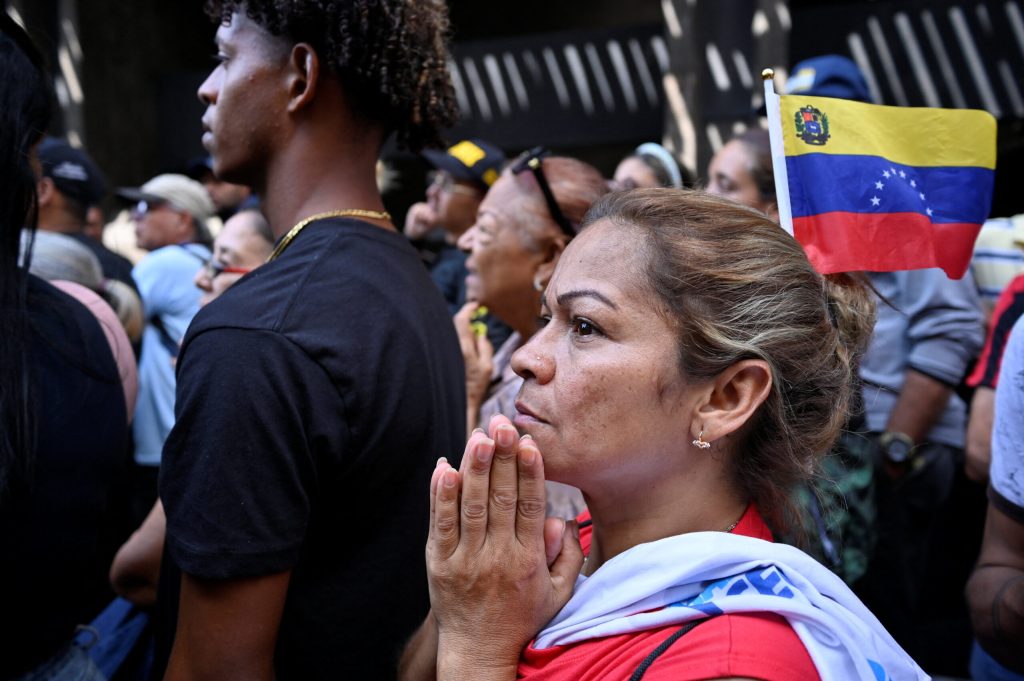
As news of Maduro’s capture spread, exiled Venezuelans, including many Jews, celebrated in plazas and communities abroad, though celebrations were tempered by uncertainty about what would follow. In Venezuela, the country’s small Jewish community adopted what one report called a “wait-and-see” approach, staying low-profile out of fear of retaliation from loyalists. Venezuela’s acting leader, Vice President Delcy Rodríguez, said in a televised speech on Venezolana de Televisión (VTV) that the operation had a “Zionist-tinted” plot on state television.
As Venezuela enters a fragile transition, many Jewish exiles say they are relieved by Maduro’s removal but do not expect to return soon without clear security guarantees and economic recovery. “The Jewish population is on standby. Everyone is staying low-profile. The regime controls everything, and repression could still be very aggressive,” Samy Yecutieli, executive director of the Israel–Latin America Chamber of Commerce, told The Times of Israel. Jewish leaders who remain in Caracas describe cautious optimism about new channels of communication with transitional officials but stress that the community is still on guard.
Daniel Behar, in an interview with The Times of Israel, stated: “There is fear that the entire community might face repercussions later on,” enhancing the idea that real safety will depend on the country moving away from rhetoric, rebuilding institutions, and ensuring that minorities are not blamed for future crises. The coming months will test whether a post-Maduro Venezuela can truly rebuild, or whether decades of distrust will leave lasting impacts on its remaining Jewish population. Many Jews who left Venezuela say they hope to visit again one day, but only if the country becomes safe and stable.


Leave a Reply